
314 Youngsville Highway Lafayette, LA 70508 (337) 330-2051 Acadiana Rehab
Visiting Hours:
Monday - Friday: 4PM-8PM
Saturday: 12PM-8PM
Sunday: 8AM-8PM
What a therapy dog adds to an inpatient stay at Acadiana Rehabilitation Hospital in Lafayette
By the middle of an inpatient stay, most patients have the rhythm of the day committed to memory. Therapy in the morning, a physician at the door, therapy again in the afternoon, nursing staff coming and going, and a discharge date on the calendar that still feels further off than anyone would like. Progress by that point is genuine, though it tends to arrive in small increments: a few more feet down the hallway than yesterday, a shirt buttoned without a second pair of hands, a full meal eaten sitting upright in a chair.
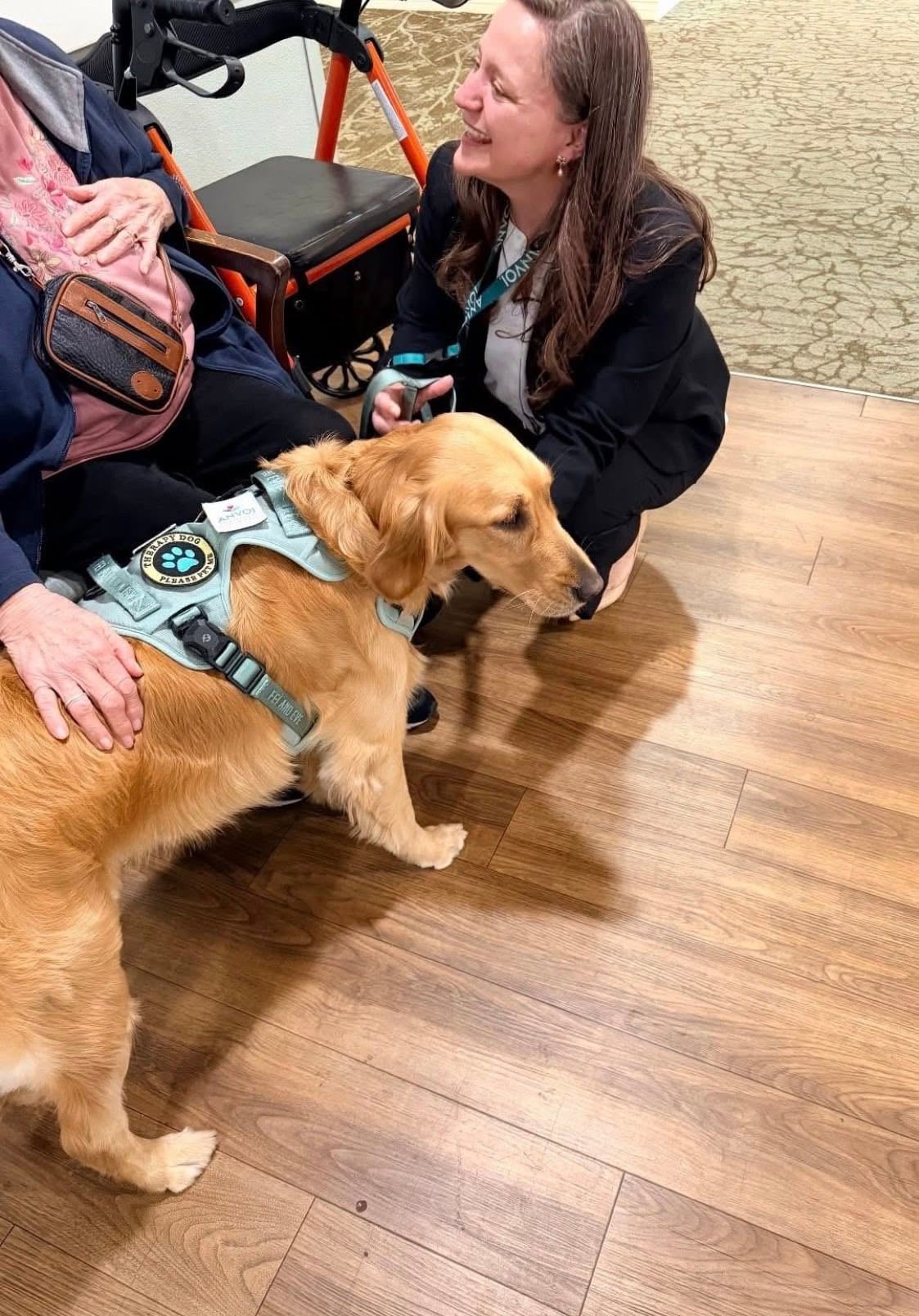
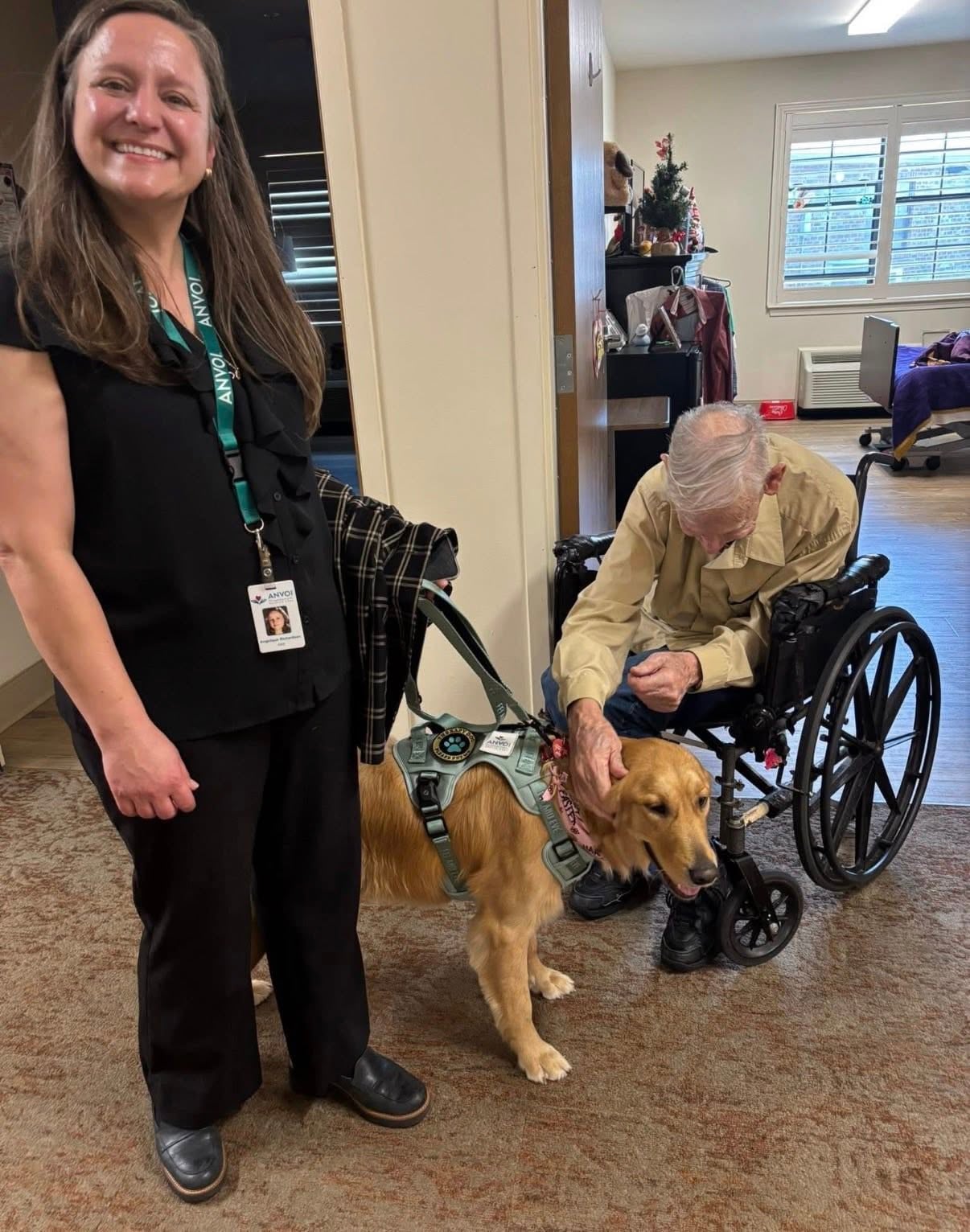
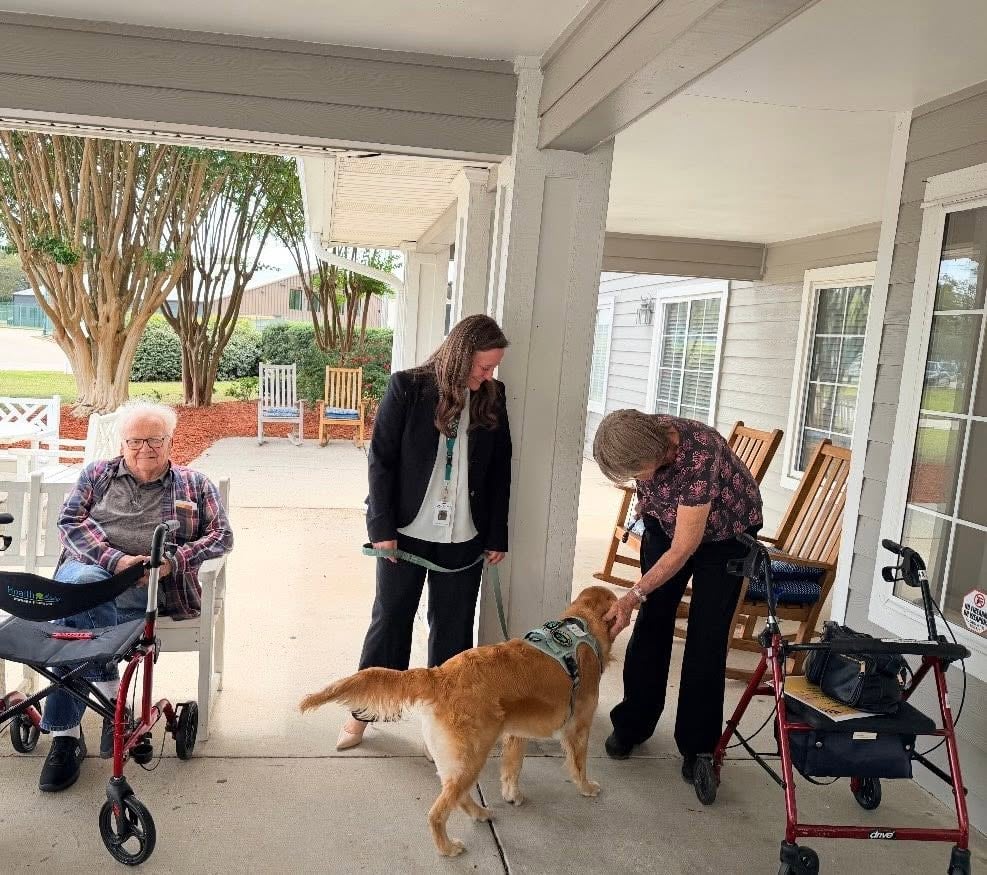
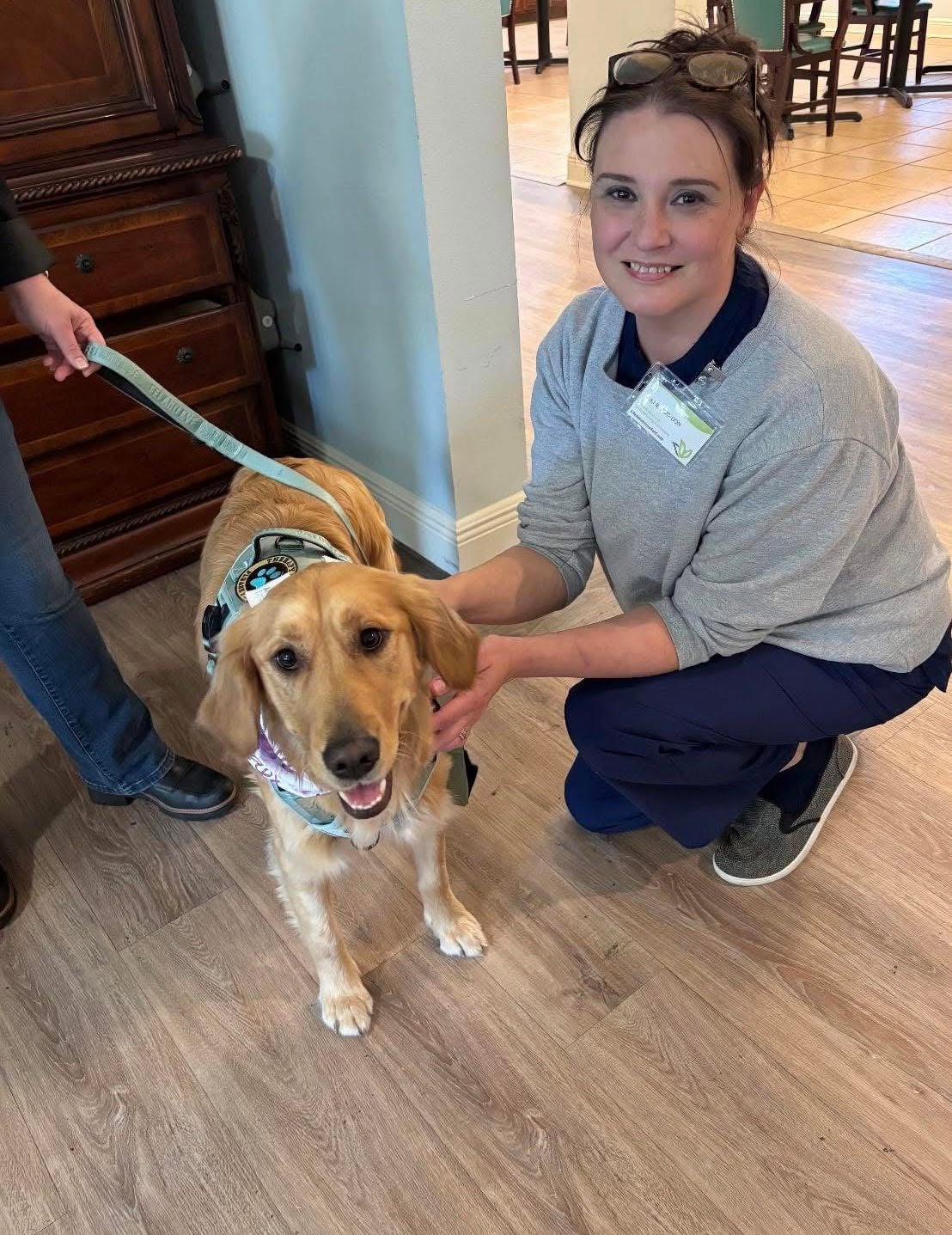
Somewhere in the middle of a week like that, a dog comes down the hallway, and for a little while the dog is the only thing anybody in the room is discussing. Luma is a therapy dog who visits patients at Acadiana Rehabilitation Hospital, and her visits ask nothing of the patient in return. There is no goal to meet, no transfer to practice, and no question to answer. A patient can put a hand on her head and that is the whole of it.
Pet therapy in rehabilitation is a narrower idea than it sounds. A therapy dog doesn't treat a stroke, set a hip, or stand in for a session with a physical therapist. What a visit offers is a break in a demanding stretch of days, and for patients who like dogs, that break can be the part of the afternoon they describe when their family calls that evening.
Patients arrive at Acadiana from an acute hospital, usually a few days after a stroke, a serious fall, a joint replacement, an amputation, or a brain injury. They are medically stable and nowhere near ready to go home alone. Inpatient rehabilitation is the stretch in between, measured in days and weeks rather than months, with discharge to home as the point of the whole stay.
A day here is full. Patients meet with a therapy team that usually includes physical therapy for standing, walking, and balance, occupational therapy for dressing, bathing, and the rest of the activities of daily living, and speech-language therapy where swallowing or communication has been affected. A physician trained in physical medicine and rehabilitation sees each patient, and nursing coverage runs around the clock.
That schedule is the reason a stay accomplishes what it does, and it's also the reason the middle of one can wear on people. Therapy asks a patient to practice the same transfer forty times, to try the stairs again on a day when the first attempt didn't go well, and to keep at it while their own house sits empty across town. Families see this happen. A patient who was determined on Monday can be quiet and discouraged by Thursday, not because anything went wrong clinically, but because repetition is tiring and a hospital room is not home.
The emotional side of recovery gets less attention than the physical side, though anyone who has sat through a long stay with a family member can describe it in detail. Recovery has a psychological dimension that runs alongside the physical one, and a therapy dog visit lives in that same territory. It doesn't change the care plan, and it can change how a Thursday afternoon goes.
Part of it is that a dog is a different kind of visitor. Everyone else who walks into a patient's room that day has a reason to be there, and the patient already knows what each of them is going to ask. A therapist will ask them to try the transfer again, a nurse will ask about pain, and a case manager will ask about the house and who is going to be in it after discharge. Luma asks for nothing, and for a patient who has spent a week being assessed, that is a genuine relief.
Part of it is what a dog does to a room. Patients who have been keeping to themselves will often lean forward, reach out, and start in on the beagle they grew up with, the one that got loose every time somebody opened the gate. Family members who have run out of things to say beyond asking how therapy went suddenly have something in front of them that isn't the illness. Conversation starts up again on its own.
Luma is a therapy dog, which means she is comfortable in hospital settings, around wheelchairs, and in rooms with more going on in them than any living room. That temperament matters more than anything she knows how to do. A therapy dog earns her place in a rehabilitation hospital by being unbothered, so a patient who is unsteady on their feet or slow to reach out is never dealing with an animal that startles.
A visit is short and low-key. Luma comes into the room, settles near the bed or the chair, and stays as long as the patient is enjoying her company. Some patients want her up close and spend the whole visit with a hand on her back. Others would rather watch her from across the room while she lies on the floor. Both are fine, and neither one is the correct way to do it.
Her visits are arranged rather than scheduled. Whether Luma comes by depends on the day, on which patients would welcome her, on nursing and therapy timing, and on whether a visit suits the patient's condition. Patients and families who would like to see her can ask a member of the care team.
One thread runs through pet therapy at a rehabilitation hospital that has no equivalent anywhere else, and it comes from the fact that nearly every patient here is going home.
A great many patients at Acadiana have a dog of their own sitting in a house in Broussard or Youngsville, being fed by a neighbor or a grandchild. For a patient in the middle of a hard stay, that dog is frequently the most concrete thing they can name about going home. Not the recliner, not the kitchen, not even their own bed. The dog.
A goal that specific is easier to hold onto than an abstract one, and "getting back to my dog" gives a patient something to say out loud on a discouraging afternoon. It also raises practical questions worth putting in front of a therapist while there is still time to practice. A patient going home to a dog has to think about bending down to a food bowl, holding a leash on the side that has the most strength, staying steady when a dog crowds a doorway, and getting up off the floor if they end up there. Occupational therapists teach one-handed methods and safer ways to reach low, and a patient who mentions the dog early gives their therapist a real target.
Families planning for discharge tend to focus on ramps, grab bars, and who will be in the house the first week, all of which matter, and the move from hospital to home takes more preparation than most families expect. The family dog belongs on that same list, because an eighty-pound retriever who greets people by jumping is a hazard to somebody five days out of a rehabilitation hospital, and solving that before discharge is far easier than solving it at home.
Visiting hours at Acadiana run Monday through Friday from 4 to 8pm, Saturday from noon to 8pm, and Sunday from 8am to 8pm. Families use that time to catch up on how therapy went, sort out logistics, and sit with somebody they are worried about, and by the second week the conversation can get thin.
A dog in the room resets that. Relatives who have been trading updates about insurance and discharge dates end up telling stories about the dogs they grew up with, and the patient joins in. Grandchildren who find a hospital room frightening have somewhere to put their attention. Family support during rehabilitation is one of the strongest things a patient has going for them, and it holds up better when visits aren't consumed entirely by the illness.
Caregivers get something out of it as well. The spouse or adult child managing appointments, medications, and a house they are barely at is carrying a load that doesn't pause because their person is admitted. A few minutes spent with a dog doesn't lift that load. It does give them one part of the visit where nobody needs anything from them.
Families who want more practical footing during a stay will find discharge planning, admission questions, and day-to-day guidance in our patient resources.
Acadiana is a 16-bed, free-standing rehabilitation hospital, and every room is private. The rooms are larger than most, with high ceilings and natural light.
That has a direct bearing on how a therapy dog visit goes. In a shared room, a visit has to account for a roommate who may be allergic, afraid of dogs, asleep, or simply uninterested, and the compromise usually lands on everybody. A private room means the visit belongs to the patient it was arranged for. Luma can settle on the floor beside the chair, a family can gather without crowding anyone, and a patient who wants her to stay a while isn't running down someone else's quiet.
Being a free-standing hospital rather than a unit inside a larger building gives the day a different shape as well. The whole place exists for rehabilitation, so the hallways and the pace of the floor are built around patients who are up and moving.
Pet therapy suits a great many patients and is wrong for some, and the difference deserves to be respected without argument.
A visit gets postponed or ruled out for reasons including:
Nursing and therapy staff make that call alongside the patient, and a patient who says no on Tuesday is welcome to say yes on Friday. Nobody is talked into it. A person who has lost a good deal of control over their own day gets to keep this one.
Acadiana Rehabilitation Hospital sits at 314 Youngsville Hwy in Lafayette, and families come in from across the region: Broussard, Youngsville, Scott, Carencro, Breaux Bridge, Opelousas, Crowley, Rayne, Jennings, Eunice, and Abbeville. Some relatives make the drive daily, others get in on weekends, and plenty are coordinating from further away.
That distance is part of why the hours between visits matter. A patient whose family can only get there on Saturday still has Tuesday and Wednesday to fill. We are the only free-standing rehabilitation hospital in Lafayette accredited by the Joint Commission, and we are physician-led, with two medical directors in physical medicine and rehabilitation. The clinical side of a stay is settled. The rest of the day, the part families ask about most, is where a dog turns out to have a role. The communities we serve stretch roughly fifty miles out from Lafayette in every direction.
Is Luma available to every patient?
No. Visits depend on the patient's condition, the day's timing, staff availability, and whether the patient wants one. Ask a nurse or therapist and they will tell you what is possible.
Does pet therapy replace any part of rehabilitation?
It doesn't. Physical, occupational, and speech therapy, nursing care, and physician oversight all run exactly as planned. A dog visit sits alongside them.
Can family members bring their own dog to visit?
Personal pets follow different rules than a trained therapy dog. Ask the nursing staff before bringing an animal to the hospital, since the answer depends on the patient, the floor, and hospital policy.
What if a patient is allergic or afraid of dogs?
There is no visit in that case. Allergies and fear of dogs both rule it out, and neither one needs to be justified to anybody.
My parent has aphasia and can barely talk. Would a visit even register?
Frequently, yes, and often more so than with patients who are speaking normally. Interaction with a dog asks nothing verbal, which is why it tends to reach patients who find conversation difficult right now.
How long does a visit last?
A few minutes, usually. Luma stays while the patient is enjoying it and moves on when they have had enough.
If someone in your family is heading into an inpatient rehabilitation stay, or is already partway through one, ask us about pet therapy the same way you would ask about anything else on their day. Call Acadiana Rehabilitation Hospital at (337) 330-2051, or send us a message, and tell us whether your person is a dog lover. We will tell you what a visit from Luma could look like and when one might be possible.
Ask about the rest of it while you have us: how admission from an acute hospital happens, what a therapy day holds, and how we plan for the afternoon your family member goes home to a dog who has been waiting by the door.
Visiting Hours:
Monday - Friday: 4PM-8PM
Saturday: 12PM-8PM
Sunday: 8AM-8PM
© Acadiana Rehabilitation 2026
All Rights Reserved